

Frequently Asked Questions

GenAI Pricing Metrics & Models

What are the main types of GenAI pricing metrics discussed in Zuora's research?

Zuora's research identifies a spectrum of GenAI pricing metrics, including flat (no metric), input-based (e.g., per user or seat), activity-based (e.g., number of queries or GPU hours), output-based (e.g., number of images generated), and outcome-based (e.g., percentage of successful customer interactions). Each metric aligns pricing with different aspects of value delivery and cost structure. [Source]

Why is user-based pricing considered insufficient for GenAI offers?

User-based pricing, while familiar and easy to implement, often fails to capture the true value and cost dynamics of GenAI. Highly active users may drive higher costs but pay the same as less active users, leading to margin erosion. Zuora's research shows that relying solely on seat-based metrics can limit agility and profitability, making hybrid or usage-based models more attractive for long-term growth. [Source]

What are the benefits of usage-based pricing for GenAI solutions?

Usage-based pricing encourages adoption by lowering initial costs, offers flexibility for customers to scale usage, aligns pricing with actual value delivered, and increases transparency. It also incentivizes providers to improve quality and enables innovation through experimentation with different pricing models. [Source]

What challenges are associated with usage-based pricing models?

Challenges include increased complexity in billing, difficulty in predicting costs and revenue, potential disputes over charges, and the need for robust real-time usage tracking. Outcome-based metrics can also be risky if results are hard to measure or agree upon. [Source]

How do hybrid pricing models work for GenAI products?

Hybrid pricing models combine elements of recurring (subscription) and usage-based charges. For example, a plan may include a base commitment with a set number of GenAI credits, with overage charges for additional usage. This approach balances predictability with flexibility and is shown to drive faster growth and higher customer retention. [Source]

What are the advantages of hybrid pricing models for GenAI?

Hybrid models offer accelerated ARR growth, scalability, higher ARPA, improved retention, and better revenue assurance. They allow customers to start with minimal commitments and scale as value is realized, supporting diverse use cases and aligning pricing with value delivered. [Source]

What is outcome-based pricing and when is it used in GenAI?

Outcome-based pricing ties charges to specific business results, such as successful customer interactions or chargeback settlements. It's suitable for solutions where value can be directly attributed to measurable outcomes, often in customer service or support use cases. Only 6% of offers in Zuora's study use this model, but its adoption is expected to grow. [Source]

How do companies benefit from experimenting with multiple pricing metrics?

Zuora's Subscribed Institute research shows that companies using 3-5 charge models, each contributing at least 10% of revenue, achieve higher year-over-year revenue growth, ARPA growth, and lower churn. Experimenting with metrics enables better value alignment and revenue optimization. [Source]

What are some predictors of success for GenAI products moving toward value-based pricing?

Success predictors include uniqueness of the underlying data set, specialization in a domain, clear attribution of value creation, fast time-to-value, scalability, regulatory compliance, and a critical position in the GenAI value chain. [Source]

Why is continuous data collection important for GenAI monetization strategies?

Continuous data collection enables companies to experiment with and refine pricing metrics, ensuring alignment with customer value and market trends. This approach supports hypersegmentation, customer-centricity, and sustainable revenue growth. [Source]

What is the 'Total Monetization' approach for GenAI according to Zuora?

The 'Total Monetization' approach involves continuously learning//iterating on pricing and packaging, using a mix of metrics and models to align costs with value delivered. It emphasizes experimentation, data-driven decisions, and customer-centricity for sustainable growth. [Source]

How do SaaS companies benefit from adopting hybrid pricing models for GenAI?

SaaS companies using hybrid models experience faster growth, higher ARPA, and better retention rates compared to those using only flat or user-based pricing. Hybrid models also provide revenue assurance and flexibility to meet diverse customer needs. [Source]

What is usage thresholding and how is it applied in GenAI pricing?

Usage thresholding sets limits on the number, speed, or quality of GenAI interactions within a plan. For example, after depleting allotted credits, users may experience slower processing or reduced quality. This helps manage costs and encourages plan upgrades. [Source]

What are some real-world examples of GenAI pricing models?

Examples include Salesforce Einstein (per user), ChatGPT Team (per user), C3.AI (per vCPU hour), Microsoft Copilot for Security (per security computing unit hour), and Adobe Firefly (per image generated with usage thresholds). [Source]

How does Zuora recommend companies approach GenAI pricing experimentation?

Zuora recommends companies experiment with a mix of pricing metrics, collect data continuously, and iterate on models to find the optimal balance between value capture and customer satisfaction. This approach supports sustainable growth and competitiveness. [Source]

What is the role of customer-centricity in GenAI pricing strategies?

Customer-centricity ensures that pricing aligns with the value customers receive, supporting fairness, transparency, and retention. It involves hypersegmentation, experimentation, and adapting models to meet diverse customer needs. [Source]

What are the key takeaways for companies developing GenAI pricing strategies?

Key takeaways include moving beyond user-based pricing, experimenting with value metrics, embracing hybrid models, focusing on customer-centricity, and continuously collecting data to refine strategies for sustainable growth. [Source]

Zuora Platform Features & Capabilities

What products and services does Zuora offer for subscription management and monetization?

Zuora offers a comprehensive suite including Zuora Billing (flexible billing for recurring, usage-based, and one-time models), Zuora Revenue (automated revenue recognition), Zuora Payments (global payment management), Zuora CPQ (configure, price, quote for recurring revenue), Zephr (personalized subscription journeys), Zuora Platform (shared data, workflows, integrations), Zuora Collections (AI-powered collections), and Accounts Receivable automation. [Source]

What integration options does Zuora provide?

Zuora offers over 60 pre-built connectors (e.g., Salesforce, HubSpot, NetSuite, Snowflake), REST and SOAP APIs, warehouse connectors (Databricks, BigQuery, RedShift), support for 40+ payment gateways, Zephr extensions, a Connect Marketplace with nearly 100 apps, and data connectors for platforms like Amazon Athena and Google BigQuery. [Source]

Does Zuora provide APIs for integration and development?

Yes, Zuora provides REST and SOAP APIs for integration with external systems, supporting billing, payment, and subscription management. Developer resources, SDKs, and guides are available in the Zuora Developer Center. [Source]

What technical documentation and resources are available for Zuora users?

Zuora provides extensive technical documentation, including platform docs, developer resources, knowledge base articles, SDK references for Zephr, and guides for payment gateway integration and advanced CPQ functionalities. [Source]

What real-time product performance metrics does Zuora support?

Zuora enables real-time tracking of profitability, conversion rates, and discounting rates, helping businesses respond quickly to market trends, optimize pricing strategies, and improve sales velocity. Integration between CRM and CPQ tools ensures data visibility for analysis. [Source]

Use Cases & Industry Applications

Who is the target audience for Zuora's platform?

Zuora targets subscription-based businesses across industries such as technology, SaaS, media, healthcare, consumer goods, manufacturing, telecommunications, and entertainment. Key roles include finance professionals, IT leaders, product managers, operations teams, and sales/customer success teams. [Source]

What industries are represented in Zuora's customer case studies?

Zuora's case studies span collaborative work management, communications, consumer goods/retail, corporate services, energy/utilities, finance, healthcare, high tech, home services, HR technology, manufacturing/IoT, media/publishing, OTT/entertainment, software/technology, telecommunications, and video games. [Source]

Can you share specific customer success stories using Zuora?

Yes. Zoom scaled from 10M to 300M users, The Financial Times grew digital subscriptions, Asana improved SSP analysis and close speed, Hudl saved 100+ hours/month, and The Seattle Times improved conversions by 30% and retention by 25%. See more at Zuora's Customer Case Studies.

What business impact can customers expect from using Zuora?

Customers can expect recurring revenue growth, operational efficiency, improved retention, faster time-to-market, streamlined financial operations, scalability, and global compliance. For example, Swiftpage saw a 140% increase in subscription customers and 131% ARR growth. [Source]

Pain Points & Solutions

What common pain points do Zuora customers face before adopting the platform?

Common pain points include slow manual close cycles, compliance challenges (ASC 606/IFRS 15), scaling usage-based/hybrid monetization, multi-entity/currency compliance, revenue leakage, poor data quality, spreadsheet dependency, quote-to-cash misalignment, and forecasting difficulties. [Source]

How does Zuora help solve these core business problems?

Zuora automates financial close and reconciliations, ensures compliance, supports diverse pricing models, simplifies global operations, automates collections, provides unified reporting, reduces spreadsheet dependency, aligns quote-to-cash, and enhances forecasting accuracy. [Source]

Implementation & Support

How long does it take to implement Zuora and how easy is it to start?

Implementation can be as fast as 30 days for focused scopes, typically 30-90 days, or several months for complex programs. Pre-built connectors enable rapid integration. Extensive training, 24x5 support, and developer resources make onboarding straightforward. [Source]

What support and training resources does Zuora provide?

Zuora offers Quick Start Tutorials, Zuora University (500+ courses), 24x5 live support, email/online ticketing, premium support options, developer resources, and a community portal for peer engagement. [Source]

Security & Compliance

What security and compliance certifications does Zuora hold?

Zuora is certified for PCI DSS Level 1, SSAE 16 SOC1 Type II, SOC2 Type II, ISO 27001, HHS HIPAA, and SOC 3, ensuring high standards for data protection and regulatory compliance. [Source]

How does Zuora ensure data security and compliance for its customers?

Zuora employs enterprise-grade security measures such as data encryption, role-based access controls, regular audits, and built-in compliance features to support GDPR, PCI DSS, SOX, and global regulatory requirements. [Source]

Customer Experience & Proof

What feedback have customers given about Zuora's ease of use?

Customers like Mindflash, TripAdvisor, FireHost, Briggs & Stratton, Buildium, and AppFolio have praised Zuora for its flexibility, ease of use, rapid integration, and ability to simplify operations and reporting. [Source]

Who are some notable Zuora customers?

Notable customers include Zoom, Box, Zendesk, Asana, AppDynamics, The Financial Times, The Guardian, Schibsted ASA, The Seattle Times, Siemens Healthineers, 24 Hour Fitness, GoPro, Fender, Schneider Electric, Caterpillar, Konecranes, Dell, Ford, Toyota, and General Motors. [Source]

Why should a customer choose Zuora over other subscription management solutions?

Zuora stands out for its flexibility (supporting 50+ pricing models), scalability (proven by customers like Zoom), AI-powered tools (Zephr), hybrid monetization, compliance certifications, and a track record of supporting rapid growth and measurable results for leading companies. [Source]

STATE OF GENAI MONETIZATION RESEARCH REPORT

A Glimpse into the Future of GenAI Pricing Metrics and Models

A data-driven analysis of offerings from 70+ companies

Authored by: Michael Mansard, EMEA Chair of the Subscribed Institute

White Toggles

Methodology: In this ongoing data-driven analysis, we examine the monetization strategies of over 70 companies with GenAI offers. Research, analysis, and recommendations based on publicly available information from press releases, articles, and vendor websites as of April 2024.

Explore the insights

Click the links below to read more about the 
topics that interest you most.
black arrow pointing down

As artificial intelligence (AI) and Generative AI (GenAI) continue to revolutionize multiple industries, effective monetization strategies are a vital ingredient for companies to keep up with adoption and sustain growth. Balancing innovation with sustainable revenue models, while also ensuring customer satisfaction and market competitiveness is paramount. 

Throughout this series, we’ve examined over 70 GenAI offers in order to identify key strategies for balancing the major factors involved in the launch of a GenAI offer: overcoming the monumental costs, driving adoption, and capturing value.

We’ve also looked at the leading trends in how these GenAI offers are being positioned and packaged, shining a light on the benefits and challenges of the various monetization strategy decisions companies currently face.

In this article, we’ll explore the range of GenAI pricing metrics and models, highlighting the accelerating shift towards usage-based (also known as consumption-based) pricing metrics and value-focused strategies, such as hybrid models, to better align prices with the actual value delivered to customers, while also hedging against the costs.

Explore the rest of the series on GenAI monetization:

We find that traditional seat- or user-based pricing, though common, is no longer sufficient to capture the unique and dynamic value of GenAI. In fact, the answer likely isn’t to be found in any singular pricing model. Instead, as a handful of visionaries in the space have already discovered, adopting a Total Monetization approach for GenAI requires a continuous journey of data collection and experimentation in order to arrive at an end-to-end strategy (Exhibit 1). 

Exhibit 1: Learn and iterate to achieve GenAI Total Monetization
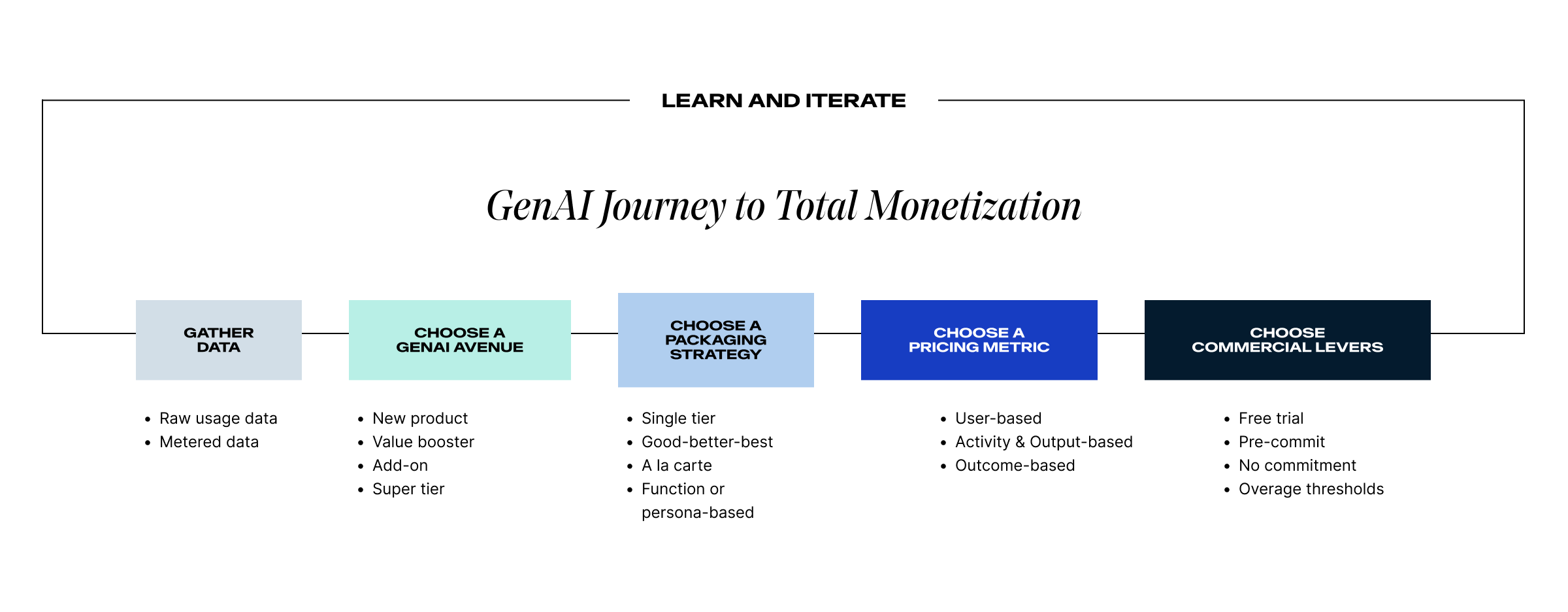
Flowchart titled "GenAI Journey to Total Monetization" with five steps: Gather Data, Choose a GenAI Avenue, Choose a Packaging Strategy, Choose a Pricing Metric, and Choose Commercial Levers.

“We’re firmly in the adoption foot race, but as consumption usage and value patterns emerge, we would expect the pricing models to continue to evolve.”

– Colin Carroll, Pricing and Commercial Excellence at PwC

Watch the full webinar

Section 1: Learning from GenAI pricing metric trends

A pricing or value metric is a quantifiable measure that forms the basis for pricing a product or service. Selecting the appropriate pricing or value metric is crucial because, ideally, it should align the price of the service with the value it delivers. This helps ensure fairness and transparency in pricing, which can significantly affect customer satisfaction and retention.

As seen below, these units or metrics range from declarative and committal, such as a “number of users,” to usage-based, such as “number of chat responses” (Exhibit 2).

Exhibit 2: GenAI pricing metrics fall across a spectrum
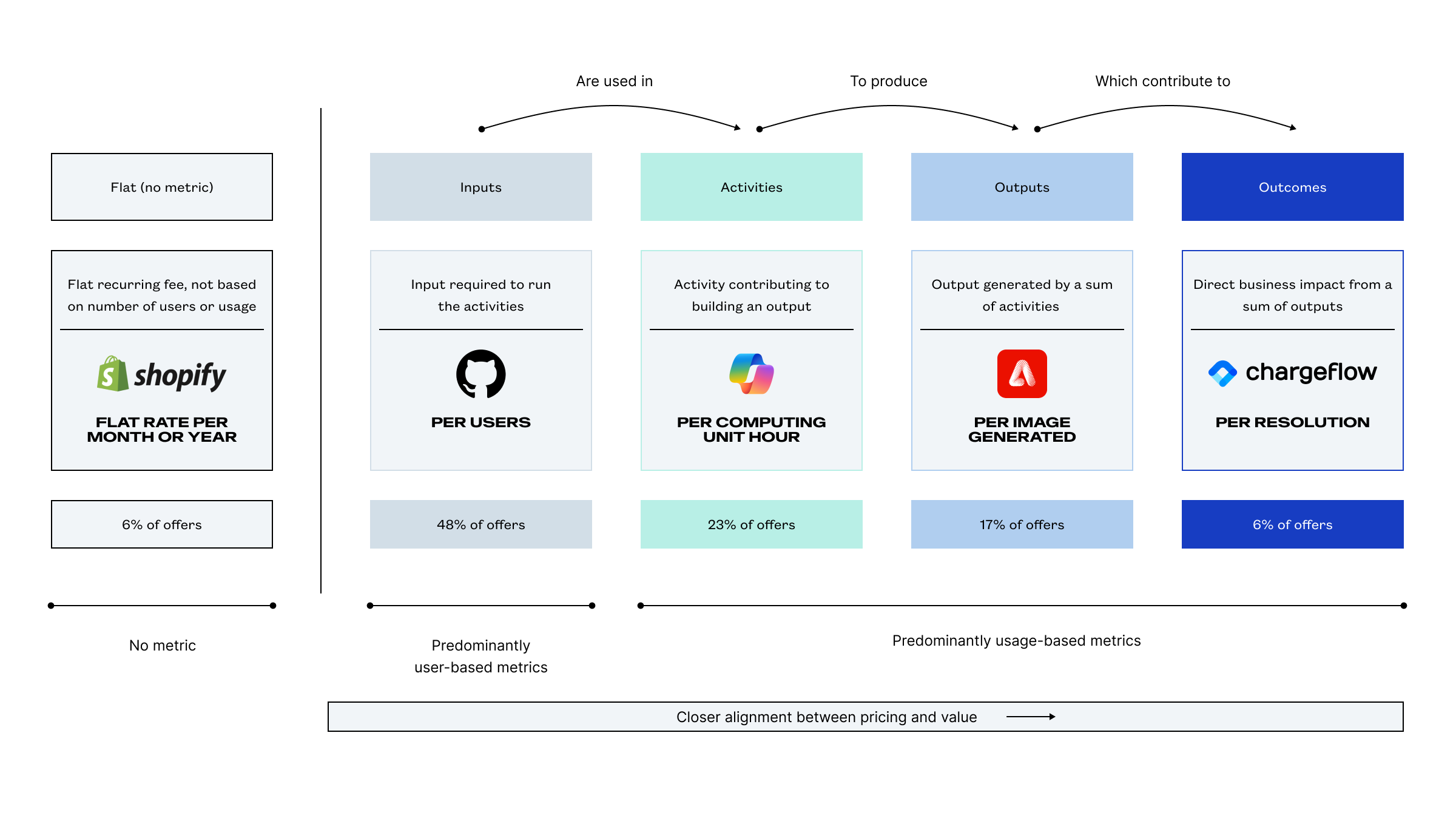
A flowchart detailing how different metrics (flat rate, per user, per computing unit hour, per image generated, per resolution) align with inputs, activities, outputs, and outcomes in pricing and value.

Spectrum of pricing metric options:

  • Flat (no metric): Subscription models that do not charge based on a metric. Given that these products are typically targeted towards consumers and SMBs more than enterprises, this approach makes sense. 
  • Inputs: Focus on the resources required, or inputs, to run GenAI processes, such as the number of users or seats. For example, GitHub charges per user for its Copilot tool.
  • Activities: Based on specific actions that contribute to an output, such as the number of GenAI queries or GPU hours used. Companies like C3.AI, for example, charge per virtual CPU (vCPU) hour. Microsoft’s Copilot for Security is charged per security computing unit hour. 
  • Outputs: Relate to the tangible outputs generated by GenAI activities, such as the number of emails or images generated. Adobe Firefly, an AI-powered image generator, meters usage per number of images created.
  • Outcomes: Measure the business impact achieved through GenAI, such as the percentage of successful customer interactions. Chargeflow charges per successful chargeback settled in the customer’s favor.

As Exhibit 2 shows, a small percentage of the offers in our study rely on flat-fee pricing—not using a metric at all. However, it seems that most companies recognize that not employing a pricing metric is growth prohibitive. Studies show that companies who use a metric grow 30% faster than those who don’t. Selecting the right pricing metric is critical as it ensures fairness, transparency, good value realization, and customer satisfaction and retention. 

And while nearly 50% of offers are currently in the input-based category (Exhibit 2), the situation is a bit more complex. As we’ll discuss in Section 2, some of these seat-based offers are already infusing some level of usage-based metering and thresholding on top of user-based pricing. 

But first, let’s take a closer look at what our research reveals about how companies are currently using each of these 4 metric types to track and monetize their GenAI offers. 

Inputs

Our research has uncovered that input-based metrics, such as per user or per seat, are the most prevalent for GenAI. This is because these well-established SaaS pricing metrics offer a familiar and easy way to quickly take new offers, like GenAI, to market. As a result, input-based metrics are used by more than half of the 70+ offers we analyzed—especially GenAI Applications (Exhibit 3). Notable examples include the Salesforce Einstein add-on, which is priced at $70/month per user and ChatGPT Team at $25/month per user. 

Exhibit 3: Pricing metric distribution for GenAI applications and models*
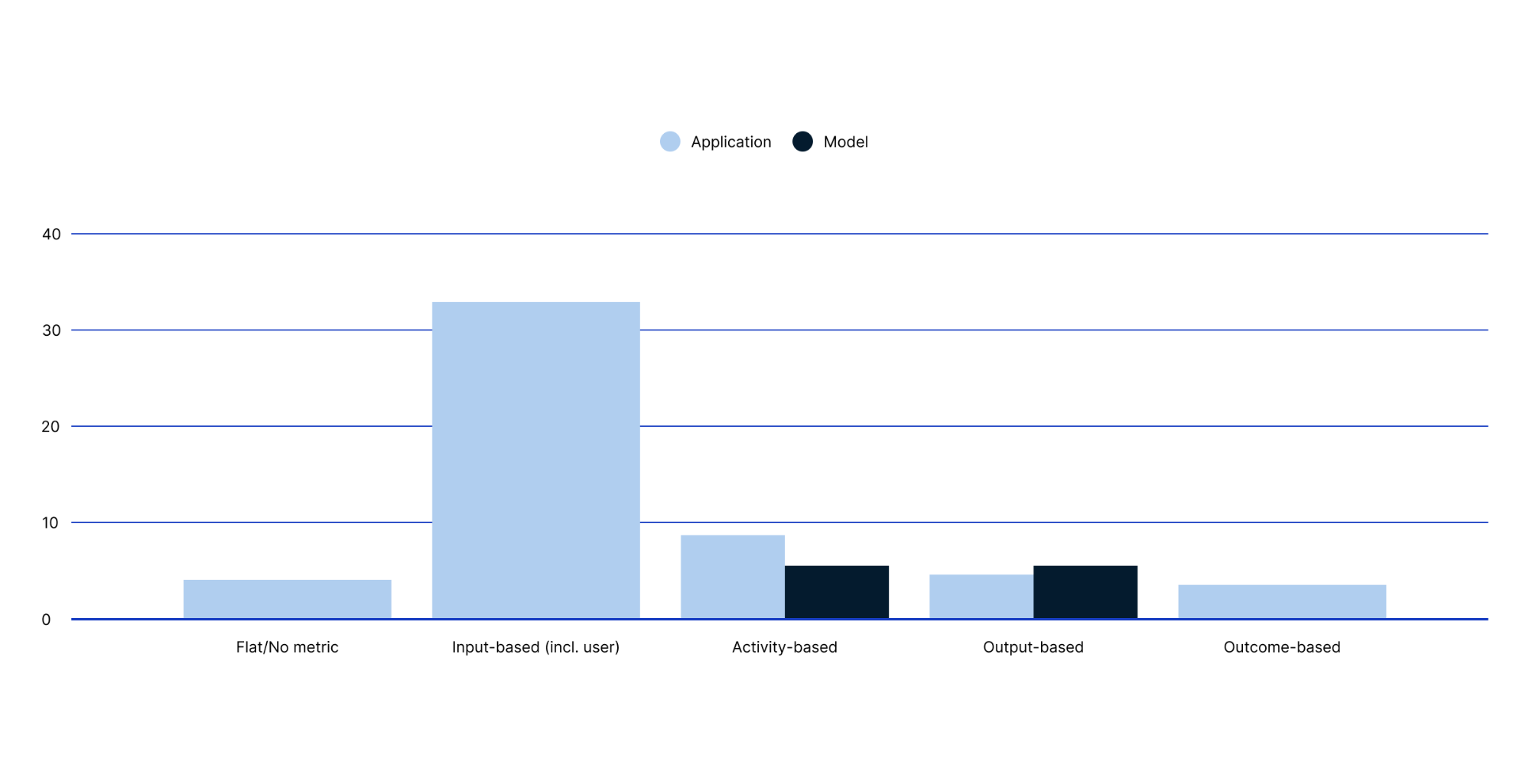
Bar chart comparing application and model metrics. Input-based metrics dominate, especially for applications, followed by lower values for activity-based, output-based, and outcome-based metrics.

*For more information on the GenAI value chain, check out our previous installments: Monetizing GenAI: Why most SaaS companies are missing out  and The Leading Packaging Models for GenAI

While this tried and true method works well in the early launch stage and does help foster adoption, the novelty of GenAI technologies is forcing product leaders and executives alike to step back and reevaluate pricing best practices. In fact, early data indicates that using seat-based metrics in isolation can result in an adverse effect for GenAI offers.

Here’s why. It’s like the old gym membership paradox or the ill-fated Delta Unlimited Flight Pass—a highly active user, who should extract more value from the service, is charged the same as a less active user. In the end, these more engaged users drive lower margins, but user-based metrics cannot track or accommodate for this variation in value delivery and costs. This means that providers are not incentivized to cater to these users, who should be their bread and butter.

This misalignment could have disastrous consequences. Microsoft’s GitHub Copilot is already reportedly feeling this pain, losing an average of $20 per user each month, and sometimes as much as $80/month for active users. This provides a perfect illustration of why, in the enterprise setting, buying chatbot or copilot licenses for every single employee likely isn’t cost effective at this point in time.

In the long term, vendors anchoring on input-based metrics alone will suffer from more limited agility and profitability, as rigid pricing restricts value capture and becomes a bottleneck for future revenue growth. With this in mind, we predict that user-based pricing will only be a transitional model for the majority of GenAI offers. In fact, an ever increasing number of companies are already moving to value-based models that leverage usage-based metrics—in addition to user-based metrics.

Let’s take a closer look at more effective value-based approaches. 

A transition from user-based to usage-based metrics

Usage-based pricing, also known as consumption or metered pricing, is a model that charges customers based on their actual usage of a product or service. This approach has gained significant traction in recent years, particularly in industries such as telecommunications, utilities, SaaS—and now—AI. 

With the recognition that flat or user-based pricing alone may not be adequate for GenAI, many companies are beginning to employ usage metrics—such as activities, outputs, and outcomes—to measure and set thresholds on GenAI usage. 

Benefits of usage-based metrics:

  • Encourages adoption: Lower initial costs can drive higher adoption rates, as customers only pay for what they use.
  • Flexibility: Customers can start with minimal commitment and scale up their usage as they see value, providing a low-risk entry point.
  • Customer retention: Continuous alignment of pricing with actual activities, outputs, or outcomes helps maintain customer satisfaction and loyalty, as they pay in proportion to their usage.
  • Usage visibility and transparency: Real-time tracking of activities allows customers to monitor their usage and spending, increasing transparency as well as customer satisfaction and control.
  • Incentivizes quality: Providers are motivated to improve the quality and efficiency of their GenAI to maximize outputs or outcomes, benefiting both parties.
  • Innovation and experimentation: Providers can test and iterate on different activity-based pricing models to find the optimal structure that maximizes both customer satisfaction and revenue.
  • Enhanced competitive advantage: Providers offering usage-based pricing, especially outcomes, may stand out in the market, attracting customers looking for guaranteed results.
  • Aligns with cost: Even though it is usually not advisable to price based on costs for intangible services such as GenAI, usage-based metrics can potentially help mitigate the associated high costs and lower profit margins.

Challenges of usage-based metrics:

  • Potential for complexity: When usage-based metrics are used in isolation, without some level of commitment, managing and predicting costs and revenue can be more challenging for both providers and customers.
  • Billing complications: The billing process can become more complex, leading to potential disputes over charges. Real-time customer usage data visibility becomes vital—across the business.
  • Risky for providers: With outcome-based metrics in particular, there’s a high risk if the desired results are not achieved or are difficult to measure. Both the vendor and the customer will need to align on and agree to a set definition for what constitutes a successful outcome. 
  • Customer overcommitment: If there is some level of commitment, there’s a risk that customers might commit to more usage than they can sustain, especially for new and developing innovations like GenAI services, where use cases and value are still being explored. 

Activities and outputs

Activity-based and output-based metrics are already the go-to approach for GenAI offers in the model layer of the value chain (Exhibit 3). Yet in those cases, they are set mostly in a “cost plus” spirit, in other words, aligning the cost model to the revenue model. This is likely because it’s the typical way for IaaS and PaaS providers (Azure, Google Cloud Platform, AWS, etc.) to sell, and they’re addressing similar buyers. And users themselves are not directly accessing GenAI models per se; instead, the consumption originates from another system at the application level. 

Yet, each and every “token” of activity or output has a very different value, depending on the use case and context that is run in the application layer (Exhibit 4). 

Exhibit 4: Activity-based and Output-based metric examples
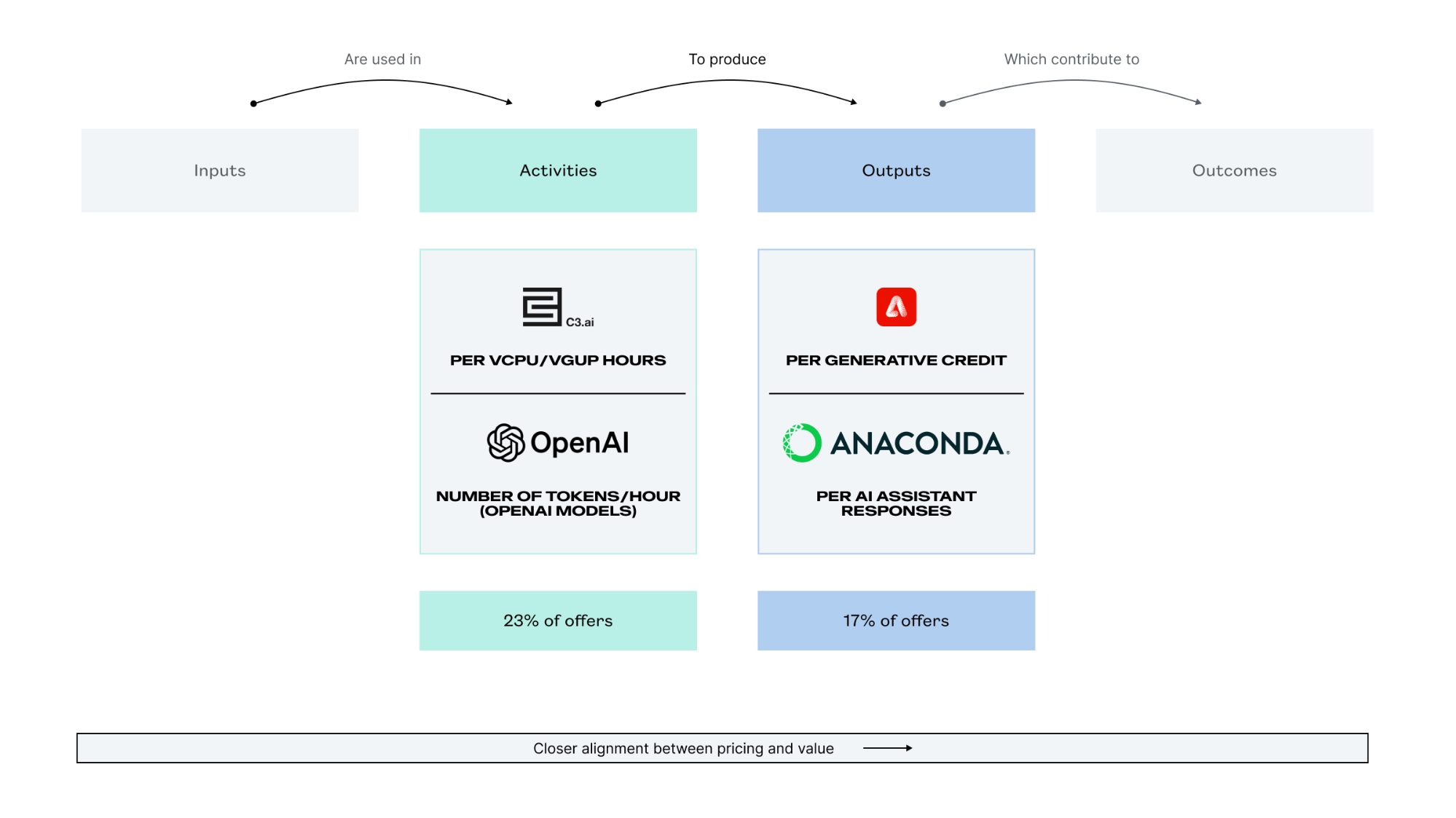
A flowchart depicting the relationship between inputs, activities (including CPU/GPU hours and tokens/hour from OpenAI), outputs (such as generative credits from OpenAI and assistant responses from Anaconda), and outcomes.

Outcomes

Suitable for GenAI solutions that deliver specific business results, outcome-based metrics underscore the value of GenAI by directly linking the price to the business outcomes it helps achieve. This type of metric works well in industries focused on performance metrics like sales and marketing automation or financial forecasting.

Well designed outcome-based models can even further optimize value capture, as they are customer-centric metrics by their very nature, aligning with customers’ strategic objectives, such as achieving customer service resolutions or chargeback settlements (Exhibit 5). Such metrics do require a mutual understanding of value between the provider and the user. To do this, vendors will need time to uncover the underlying cost and value drivers of the process or workflow covered by the solution for both parties.

This is why early adopters of outcome-based models are usually found in customer service or support use cases, where the cost to reach a resolution is already known. Intercom, an AI customer service solution, is a perfect example of this (Exhibit 5). 

Exhibit 5: Outcome-based metric examples
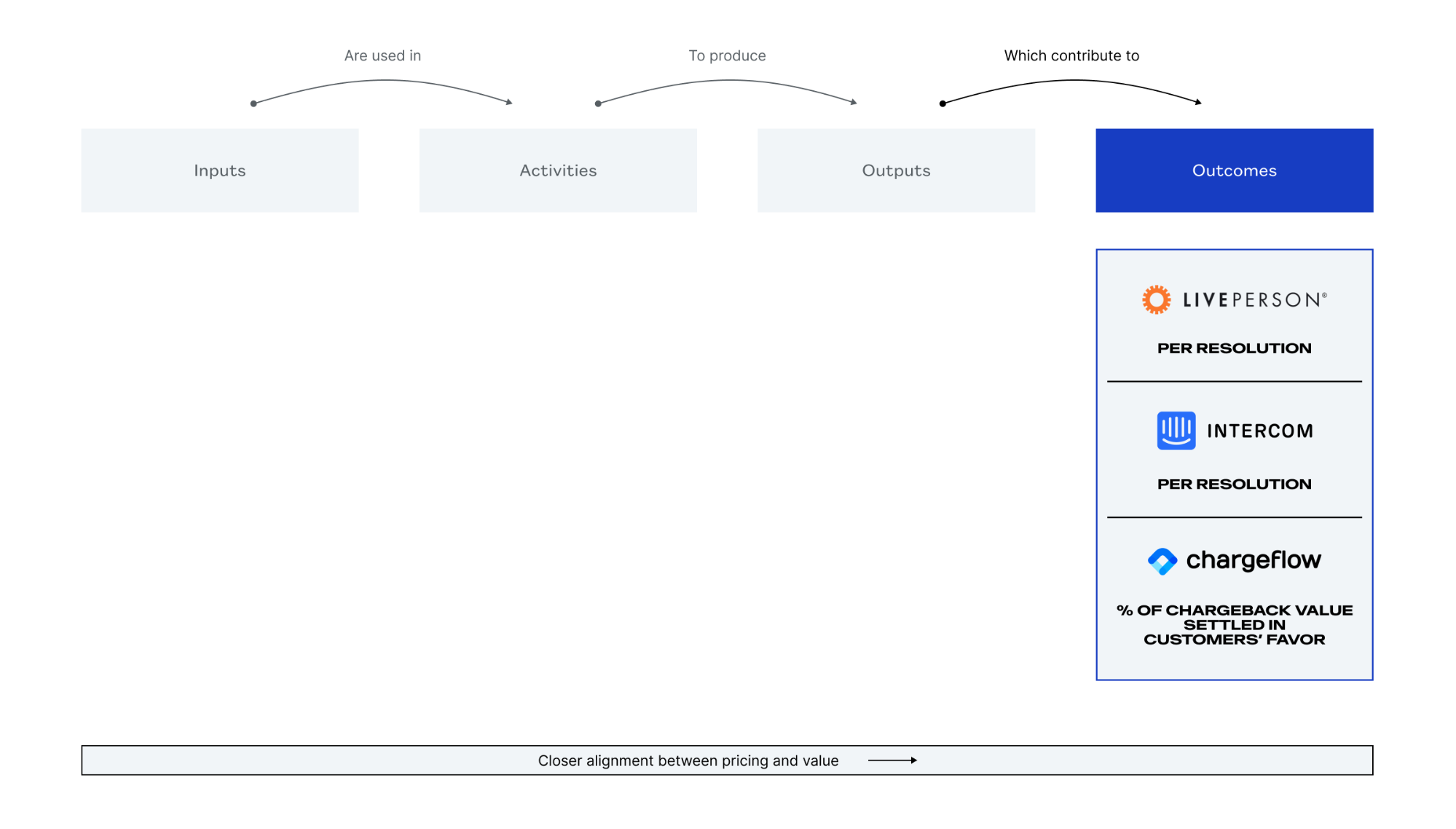
Diagram depicting a flow from Inputs to Outcomes with Activities and Outputs in between. Outcomes feature companies LivePerson, Intercom, and Chargeflow, highlighting their resolution and chargeback metrics.

Although outcome-based metrics are only used by 6% of the offers in our study (Exhibit 3), throughout this series, we’ve predicted an increase in such metrics in the coming months and years, as companies continue iterating on their monetization strategies to optimize value realization. 

While industry-specific GenAI solutions like Harvey.ai and Hippocratic.ai don’t appear to be using outcome-based metrics at this time, there is a strong argument to be made for the growth potential of such a strategy. 

In our previous installment, we also predicted that such solutions would shift towards persona- or function-based packaging over time for similar reasons—both strategies aim to align pricing and packaging with the value the customer actually receives.

The following attributes can be predictors of the success of GenAI products in moving towards a more value or outcome-oriented model, thus capturing a higher value premium of the solution.

Uniqueness of underlying data set

Exclusivity, depth, and rarity of the data used to train the GenAI model, especially if the data set provides unique insights or competitive advantages.

Specialization

Specialization in a specific domain or use case, addressing clear problems with high precision, making it more valuable to targeted customers.

Attributability of value creation

Ability for the solution to be directly linked to quantifiable impact in terms of value creation and continuous return on investment (revenue growth, cost savings…).

Time-to-value

Speed with which customers can deploy the solution and begin realizing tangible benefits, as quick wins support investment justification and prioritization.

Scalability of solution

Ease with which the solution can be scaled elastically to accommodate growth in data, users, or complexity, affecting long-term value and adaptability.

Regulatory and local compliance

Adherence to relevant regulations and data privacy measures, especially niche or local ones, minimizing legal risks for customers.

Position in the GenAI value-chain

Criticality within the broader GenAI ecosystem. 

As companies move towards outcome-based metrics, this will require more data and understanding of  jobs-to-done. This will lead to hypersegmentation of offers, using a mix of carefully selected customer-centric metrics. 

Luckily, existing data already proves the growth potential of this approach. Subscribed Institute research shows that companies that have 3-5 charge models, where each charge model contributes at least 10% of total revenue, perform the best when it comes to year-over-year revenue growth, average revenue per account (ARPA) growth, and average monthly churn rate (Exhibit 6). In the next section, we’ll dive into the proven pricing models that can help achieve this growth. 

Exhibit 6: Businesses with more charge models perform better 
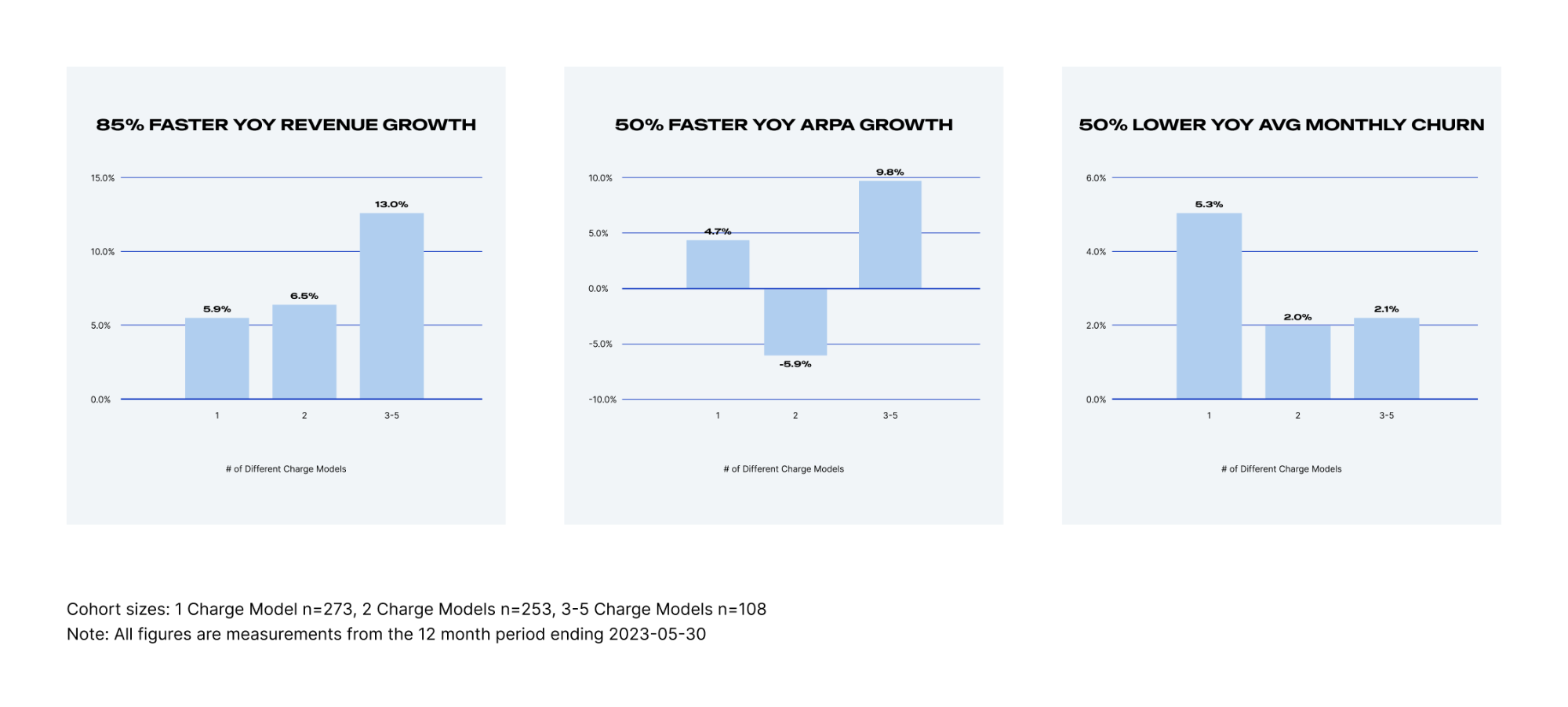
Three bar charts showing differences in revenue growth, ARPA growth, and churn rate for 2, 3, and 5 charge models. Notes below specify cohorts and measurement periods ending May 30, 2023.

Section 2: Combining pricing metrics into models for GenAI

Now that we’ve covered pricing metrics, let’s take a look at the types of commercial levers and pricing models—or mix of models—companies are using to take their GenAI offers to market. 

Nearly half of the GenAI offers we studied employ a committed recurring model, often using an input-based metric (Exhibit 7). In these instances, the offer usually includes unlimited use of GenAI, often with a fair use policy (NotionAI is an example of this). Or, the committed recurring plan may include a number of GenAI interactions or credits that can be increased by moving to a higher tier. Both HeyGen and Anaconda Assistant appear to be adopting this tactic.

If we dig a little deeper, we can see that vendors are already employing a range of pricing models.

Combining the best of both worlds with hybrid models

While most GenAI applications initially adopt flat or user-based pricing due to the simplicity and familiarity of such models, an ever increasing number of visionaries are adopting hybrid pricing models. For GenAI, where revenue growth is currently hard to come by, this is a great strategy. In fact, research shows that SaaS companies employing these models achieve faster growth than their peers. 

However, as we discussed in the first installment in this series, the ultimate aim of GenAI monetization is not merely competitive pricing, but creating true value. Despite the pressures to cut costs and automate, the path forward is about aligning costs closely with value delivery.

Hybrid pricing models can help achieve this alignment by integrating a mix of pricing metrics, such as input-based and outcome-based models, optimizing value capture and driving revenue growth (Exhibit 7). 

Whereas seat-based pricing alone cannot scale with the changing demands and capabilities of GenAI, layering usage on top can help improve scalability. In fact, over 50% of the offers in our study are already employing some type of hybrid model, often combining pre-commitment or recurring commitments with some level of usage-based pricing (Exhibit 7). 

Exhibit 7: GenAI pricing metrics and models
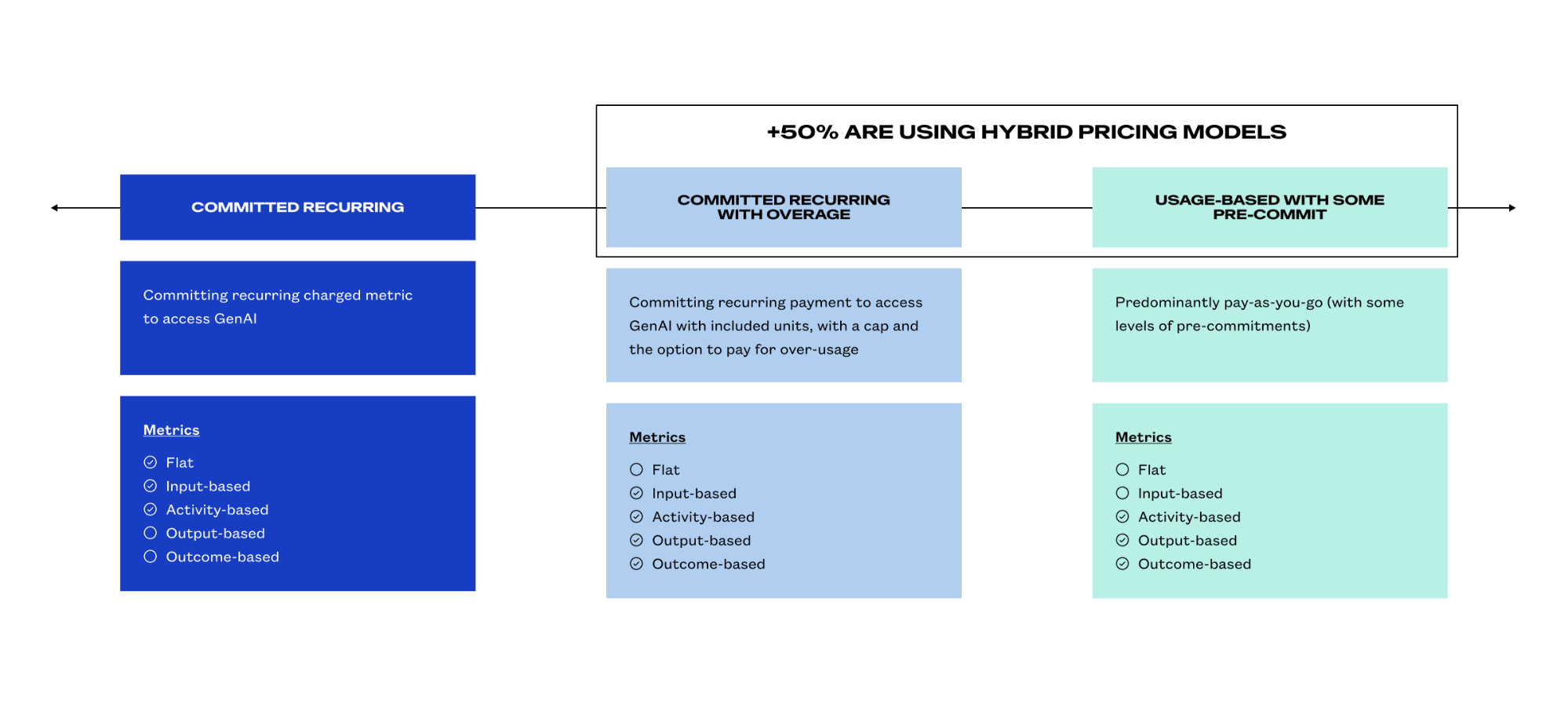
A chart shows three pricing models: Committed Recurring, Committed Recurring with Overage, and Usage-Based with Some Pre-Commit. Each model lists potential metrics, which include flat, input-based, output-based, and activity-based.

Unlike simple recurring charges that are usually charged in advance, these hybrid models come with more complexity. Hybrid pricing models range from predominantly pay-as-you-go consumption, to pre-pay with drawdown, or pre-pay a minimum commitment and pay for overages.

Usage- or consumption-based hybrid models are already widespread in the GenAI model layer of the value chain. These offers, such as MistralAI, often employ output-oriented metrics such as pay-per-token. While Chargeflow and a few other pioneers are already employing outcome-oriented metrics, such as % of chargeback value settled in your favor. 

Committed recurring with overage models usually take the form of input-based pricing combined with a set number of generative credits, some form of usage thresholding, and the option to purchase more upon overage.

Usage thresholding can help companies overcome the monumental costs of GenAI. At the moment, we see three variations:

  1. Quantity thresholding: the number of interactions per period are limited.
  2. Speed thresholding: the speed of processing is limited.
  3. Quality thresholding: the quality of the model used or the generated output is inferior.


Adobe Firefly wisely combines these thresholds, given that users can still continue using the service after depleting their allotted credits, however the processing time may be slower, tasks may be limited, or image quality may be reduced.


Exhibit 8: A spectrum of metrics used to build a spectrum of hybrid models
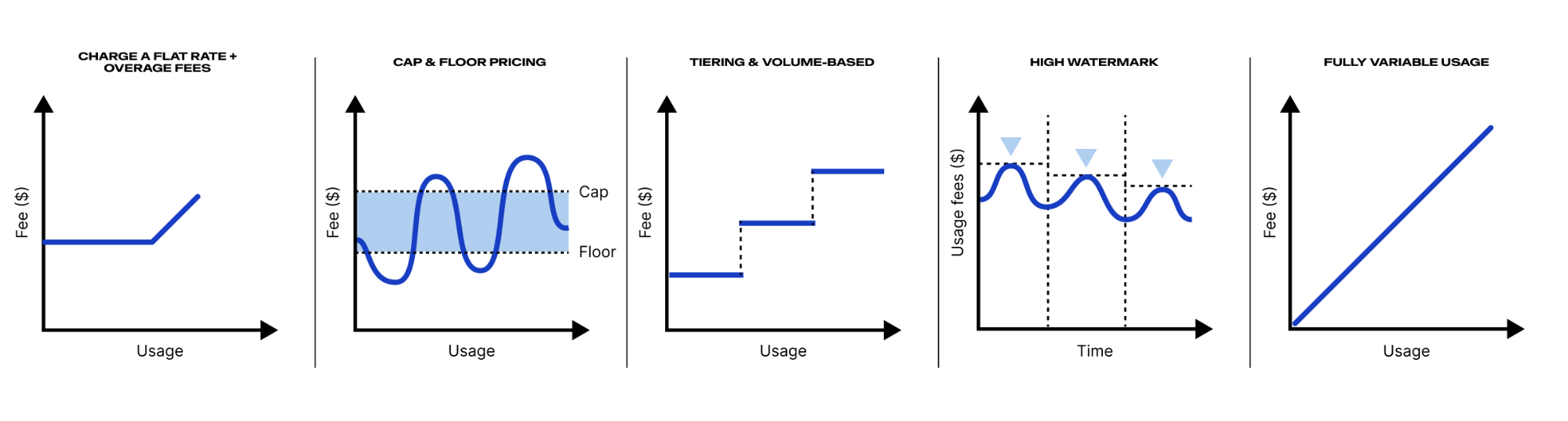
A diagram with five different pricing models: Charge flat rate & overage fees, Cap & floor pricing, Tiering & volume-based, High watermark, Fully variable usage. Each model is shown with a corresponding graph.

Lastly, there are many metric mixing options for hybrid models, ranging from a tiering model (similar to tax brackets) to a high watermark model, where charges are based on the highest level of usage or service consumption within a specific period A non exhaustive visual list is provided in Exhibit 8. To summarize, this just adds one last dimension in the immense, if not infinite, scope of pricing and packaging possibilities. 

Hybrid models do require a strong discipline in customer usage metering to ensure revenue assurance, given the risks of revenue leakage when managing complex models. But with the right strategies and tools, these models may provide the growth, scalability, and flexibility that GenAI startups and SaaS companies alike require. 

Reasons to choose hybrid models for GenAI:

  1. Accelerated annual recurring revenue (ARR) growth: Research shows that SaaS companies using hybrid models experience faster growth than those relying solely on flat or user-based pricing. By integrating both subscription and consumption-based elements, businesses can optimize value capture and drive significant revenue growth.
  2. Scalability and flexibility: Hybrid models offer the flexibility to scale with the evolving demands and capabilities of GenAI. While traditional seat-based pricing fails to accommodate changing usage patterns, adding a usage-based component helps meet diverse customer needs.
  3. Higher customer retention and average revenue per account (ARPA): By combining committed recurring payments with the right level of usage-based charges, hybrid models strike a balance that leads to higher ARPA and better retention rates.
  4. Rising preference for usage-based pricing: Both consumers and tech buyers show a strong preference for usage-based pricing, particularly in the AI and GenAI sectors.
  5. Optimal value capture: Using a mix of pricing metrics, such as user-based and outcome-based units, hybrid models ensure that pricing aligns more closely with the actual value delivered to customers, which is absolutely vital for the long term success of GenAI offers.
  6. Improved revenue assurance: Hybrid models require robust customer usage metering, which helps  minimize the risks of revenue leakage. This precise tracking and billing of usage fosters a disciplined revenue management approach.
  7. Enhanced predictability: Customers benefit from the predictability of committed recurring payments and the flexibility of usage-based charges for overages. This dual approach accommodates varied budget preferences, making it easier for customers to manage costs and scale their usage as needed.
  8. Encouragement of incremental commitments: Hybrid models allow customers to start with minimal commitments and gradually increase their investment as they recognize more value. This phased approach enables mutual value discovery and stronger long-term engagements.
  9. Support for diverse use cases: These models cater to a wide range of metrics, from output-oriented (e.g., pay-per-tokens) to outcome-oriented (e.g., percentage of chargebacks settled). This versatility makes hybrid pricing suitable for various GenAI applications.


Embracing flexible and customer-centric strategies for sustainable GenAI monetization

The shift towards usage-based metrics and hybrid pricing models marks a critical departure from traditional seat- or user-based pricing, which no longer adequately captures GenAI’s unique value. Adopting a Total Monetization approach, companies must continuously gather data and experiment with diverse pricing metrics to align costs with customer value and ensure competitiveness and satisfaction.

The future of GenAI monetization lies in a flexible, data-driven approach that balances cost efficiency with value delivery, ensuring long-term success and growth in the GenAI-driven marketplace​​​​​​​​​​.

Key takeaways

  • The user-based paradigm will be unsustainable for most GenAI offers, so becoming familiar and experimenting with the spectrum of value metrics is paramount.
  • Although outcome-based metrics may be the ultimate destination for some companies, getting there will require a journey, and even then, not all offers are ideal candidates for this approach. 
  • As companies fine tune their approach to more closely align pricing with value, it will require increased data collection, more customer centricity, experimentation, and hypersegmentation.


This article contains forward-looking statements that involve a number of risks, uncertainties and assumptions, including but not limited to statements regarding the expected benefits and drawbacks of releases of GenAI solutions with different pricing metrics and models. Any statements that are not statements of historical fact may be deemed to be forward-looking statements. Actual results could differ materially from those stated or implied in forward-looking statements due to a number of factors. The forward-looking statements in this article are based on current expectations as of the date of this article and Zuora undertakes no obligation to update or revise any forward-looking statements, whether as a result of new information, future events or otherwise. To the extent that this press release also includes market data and certain other statistical information, that information is based on estimates, forecasts, projections, or similar methodologies, and is inherently subject to uncertainties, and actual events or circumstances may differ materially from events and circumstances reflected in this information. As stated in the article, the recommendations are a foundational guide, but not intended to be predictions of the future or accurate advice.

Leading strategies for monetizing GenAI

Uncover the emerging trends in GenAI and discover why many SaaS companies may be missing out.

The 4 GenAI monetization avenues

Explore the leading positioning strategies of the pioneers in the GenAI monetization frontier—and the pros and cons of each. 

Packaging models for GenAI

Discover how companies are packaging their GenAI offers today and learn the strategies that will set your business up for success. 

Learn more about the author

Michael Mansard

EMEA Chair, the Subscribed Institute 

Principal Director of Subscription Strategy, Zuora

The Subscribed Institute

The Subscribed Institute is Zuora’s dedicated think tank that cultivates and serves a community of business leaders through research, content, events, and advisory services. Strategists from the Subscribed Institute are a resource for our customers to help them chart strategic, tailored paths toward recurring revenue business model success, build internal capabilities, and navigate an accelerated Journey to Usership.

Interested in learning more?

Talk to one of our experts today or speak to your account executive about scheduling a conversation.