Frequently Asked Questions

Order to Cash (O2C) Fundamentals

What is the Order to Cash (O2C) process?

The Order to Cash (O2C) process is the end-to-end business workflow that starts when a customer places an order and ends when payment is collected. It includes order entry, fulfillment, invoicing, payment processing, and collections. Streamlining O2C improves cash flow, reduces errors, and enhances customer satisfaction. [Source]

What are the main steps in the Order to Cash process?

The main steps are order entry, order fulfillment, invoicing, payment processing, and collections. Each step is interconnected to ensure accurate order processing and timely payment collection. [Source]

Why is Order to Cash important for recurring revenue businesses?

O2C is vital for recurring revenue businesses because it ensures seamless transitions from order to payment, improves cash flow, reduces errors, and increases visibility into revenue performance. Automation and integration are especially important for subscription models. [Source]

How does Order to Cash differ from Quote to Cash?

Order to Cash (O2C) covers order fulfillment and payment collection, while Quote to Cash (Q2C) includes quotinggenerating quotes, negotiation, contract creation, and then the O2C steps. Q2C is a broader process that starts earlier in the sales cycle. [Source]

What is the difference between Order to Cash and Procure to Pay?

Order to Cash (O2C) manages the process from customer order to payment collection. Procure to Pay (P2P) handles procurement, from sourcing suppliers to paying them. O2C is revenue-focused, while P2P is cost-focused. [Source]

What are the key metrics for measuring Order to Cash performance?

Key O2C metrics include Days Sales Outstanding (DSO), Average Days Delinquent (ADD), invoice cycle time, order fulfillment cycle time, payment collection efficiency, dispute resolution time, bad debt ratio, and cash conversion cycle (CCC). [Source]

What are common challenges in the Order to Cash process?

Common O2C challenges include inaccurate data, lack of visibility, manual processes, pricing complexity, and lack of integration with other business systems. These issues can cause delays, errors, and revenue leakage. [Source]

How can automation improve the Order to Cash cycle?

Automation reduces manual errors, accelerates invoicing and payment collection, improves visibility into revenue performance, and allows finance teams to focus on strategic work. [Source]

How does Order to Cash management differ for subscription businesses?

Subscription businesses require O2C processes that handle recurring revenue streams, flexible billing cycles, and ongoing customer relationships. Accurate and timely billing, as well as seamless payment collection, are essential. [Source]

What best practices help streamline the Order to Cash process?

Best practices include automating manual tasks, optimizing billing and payment processes, enhancing team communication, monitoring KPIs, and integrating O2C with your ERP system. [Source]

Zuora's Order to Cash Solutions

How does Zuora support the Order to Cash process?

Zuora provides end-to-end order management, seamless integration with billing and payment systems, and comprehensive reporting and analytics to optimize the O2C process. Its centralized platform automates order-to-cash and subscription order-to-revenue operations. [Source]

What features does Zuora offer for automating Order to Cash?

Zuora offers automation pipeline for order entry, billing, invoicing, payment processing, collections, and revenue recognition. It supports multiple pricing models, recurring billing, and integrates with ERP and CRM systems. [Source]

How does Zuora help with recurring billing and revenue recognition?

Zuora Billing supports recurring, usage-based, and one-time pricing models. Zuora Revenue automates complex revenue recognition and ensures compliance with ASC 606 and IFRS 15. [Source]

What integrations does Zuora provide for Order to Cash automation?

Zuora offers over 60 pre-built connectors (e.g., Salesforce, HubSpot, NetSuite), REST and SOAP APIs, warehouse connectors (Databricks, BigQuery), and supports 40+ payment gateways. [Source]

How does Zuora address common Order to Cash pain points?

Zuora automates manual processes, improves data quality, ensures compliance, reduces revenue leakage, and provides real-time reporting. It helps eliminate spreadsheet dependency and aligns quoting, billing, and revenue recognition. [Source]

What types of businesses benefit most from Zuora's O2C solutions?

Zuora is ideal for subscription-based businesses in technology, SaaS, media, publishing, healthcare, manufacturing, IoT, telecommunications, and more. It supports companies of all sizes, from startups to enterprises. [Source]

What are some real-world results from companies using Zuora for O2C?

Zoom scaled from 10 million to 300 million users, The Seattle Times improved new subscription conversions by 30% and retention by 25%, and Hudl saved over 100 hours per month by automating processes with Zuora. [Source]

How long does it take to implement Zuora for Order to Cash automation?

Implementation timelines vary: focused scopes can be completed in as little as 30 days, typical projects take 30–90 days, and multi-product or multi-entity programs may take several months. Pre-built connectors can enable integrations in as little as one day. [Source]

What training and support does Zuora offer for O2C users?

Zuora provides Quick Start Tutorials, Zuora University (500+ courses), 24x5 live global support, email and ticketing, premium support options, and a community portal for peer engagement. [Source]

Features & Capabilities

What are the key features of Zuora's platform for Order to Cash?

Key features include dynamic monetization (50+ pricing models), automated billing and payments, revenue recognition, global compliance, integration APIs, real-time analytics, and AI-powered collections. [Source]

Does Zuora support global currencies and tax compliance?

Yes, Zuora supports multi-currency operations and provides tools for tax compliance, making it easier to operate globally and manage complex tax regulations. [Source]

What payment gateways does Zuora integrate with?

Zuora integrates with over 40 payment gateways, including Stripe, GoCardless, and Worldpay, supporting 20+ payment methods. [Source]

Does Zuora provide APIs for custom integrations?

Yes, Zuora offers REST and SOAP APIs for seamless integration with external systems. Developers can access SDKs and guides via the Zuora Developer Center. [Source]

What technical documentation is available for Zuora's O2C solutions?

Zuora provides extensive documentation, including platform guides, API references, SDK docs, and integration guides. Resources are available at the Zuora Docs Portal, Developer Center, and Knowledge Center. [Source]

How does Zuora ensure data quality and reporting accuracy?

Zuora provides a unified platform for accurate reporting and forecasting, eliminating fragmented systems and ensuring data reliability for O2C processes. [Source]

What security and compliance certifications does Zuora hold?

Zuora is certified for PCI DSS Level 1, SSAE 16 SOC1 Type II, SOC2 Type II, ISO 27001, HHS HIPAA, and SOC 3. These certifications ensure enterprise-grade security and regulatory compliance. [Source]

How does Zuora help with audit readiness and compliance?

Zuora automates revenue recognition and reporting sea, ensures compliance with ASC 606, IFRS 15, PCI DSS, and GDPR, and provides audit trails and role-based access controls. [Source]

Customer Success & Use Cases

Who are some notable Zuora customers using O2C solutions?

Notable customers include Zoom, Asana, The Financial Times, The Seattle Times, GoPro, Siemens Healthineers, and Schneider Electric. [Source]

What industries are represented in Zuora's O2C case studies?

Industries include SaaS, communications, consumer goods, retail, energy, finance, healthcare, high tech, manufacturing, media, publishing, entertainment, software, telecommunications, and video games. [Source]

What business impact can customers expect from using Zuora for O2C?

Customers can expect recurring revenue growth, operational efficiency, improved retention, faster time-to-market, and global compliance. For example, Swiftpage saw a 140% increase in subscription customers and 131% ARR growth. [Source]

What feedback have customers shared about Zuora's ease of use?

Customers like Mindflash, TripAdvisor, FireHost, Briggs & Stratton, Buildium, and AppFolio have praised Zuora for its flexibility, ease of integration, and ability to reduce manual workloads and errors. [Source]

What roles and industries are best suited for Zuora's O2C platform?

Zuora is designed for finance professionals, IT leaders, product managers, operations teams, and sales/customer success teams in industries such as technology, media, healthcare, consumer goods, manufacturing, and telecommunications. [Source]

Why should a customer choose Zuora for Order to Cash automation?

Zuora offers flexibility (50+ pricing models), scalability (proven by Zoom's growth), AI-powered tools, hybrid monetization, compliance, and a track record of customer success. [Source]

What core problems does Zuora solve for Order to Cash?

Zuora solves slow manual close, compliance challenges, scaling hybrid monetization, multi-entity/currency complexity, revenue leakage, data quality issues, spreadsheet dependency, quote-to-cash misalignment, and forecasting difficulties. [Source]

What real-time product performance metrics does Zuora provide?

Zuora provides real-time metrics on profitability, conversion rates, and discounting rates, enabling businesses to respond quickly to market trends and optimize pricing strategies. [Source]

Glossary Hub / Order to Cash (O2C) Guide for Recurring Revenue Businesses

Order to Cash (O2C) Guide for Recurring Revenue Businesses

TL;DR :

Order to Cash (O2C) is the end-to-end business process that starts when a customer places an order and ends when payment for that order is collected. It includes order entry, fulfillment, invoicing, payment processing, and collections. A streamlined O2C cycle improves cash flow, reduces errors, increases visibility into revenue performance, and enhances customer satisfaction — especially when supported by automation and integrated systems like Zuora’s platform.


Looking to optimize your revenue management? The Order to Cash (O2C) process is vital for any business, ensuring a seamless transition from customer order to payment collection. This article delves into the intricacies of the Order to Cash process, its significance, and how you can streamline it for maximum efficiency.

What is order to cash?

The Order to Cash process, also known as O2C or OTC, encompasses all the steps involved in fulfilling customer orders, from initial order placement to final payment collection. This crucial business process is fundamental for any company selling products or services, playing a vital role in maintaining healthy cash flow and customer satisfaction.

The Order to Cash cycle starts when a customer places an order and ends when the payment for that order is received. It involves several interconnected stages: order entry, order fulfillment, invoicing, payment processing, and collections.

Key components of the Order to Cash process include:

Order Entry: Recording and entering the customer’s order into the system, gathering all relevant information like customer details, product or service specifications, pricing, and delivery instructions.

Order Fulfillment: Processing and fulfilling the order by picking items from inventory, packaging them, and preparing them for shipment.

Invoicing: Generating and sending an invoice to the customer, detailing the purchased products or services, pricing, taxes or discounts, and payment terms.

Payment Processing:
Collecting payment from the customer using their preferred method, such as credit card payments, electronic funds transfer, or checks.

Collections:
Following up on outstanding payments or delays, ensuring timely payment through reminders, negotiation, and resolution of any issues or disputes.


Optimizing your Order to Cash process can yield numerous benefits. By streamlining and automating the O2C cycle, you can reduce order processing time, minimize errors, improve cash flow, enhance customer satisfaction, and increase overall efficiency. It also offers better visibility into your sales and financial data, allowing for more accurate forecasting and decision-making.

Zuora understands the importance of an efficient Order to Cash process for your business success. Our comprehensive suite of Order to Cash solutions empowers companies to automate and optimize their entire order management and payment processes, ensuring a seamless experience for both customers and internal teams.

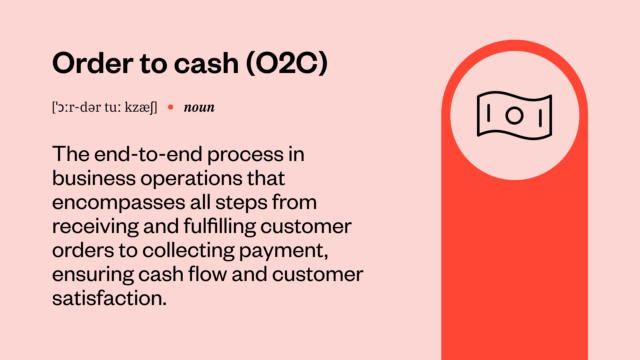
The Order to Cash (O2C) process encompasses end-to-end steps from receiving customer orders to collecting payments, ensuring seamless cash flow and customer satisfaction.

What’s the difference between order to cash and quote-to-cash?

Order-to-cash and quote-to-cash are closely related business processes, but they cover different parts of the sales cycle. Order-to-cash involves everything that turns a customer’s order into cash. Think of O2C as the phase for order fulfillment and payment collection. Quote-to-cash, on the other hand, focuses on all the processes that turn a customer quote into cash.

In terms of processes involved, O2C involves order entry, order fulfillment, invoicing, accounts receivable, payment, and cash application. Q2C includes quoting, negotiation, contract or agreement creation, order placement, fulfillment, invoicing, and payment.

Another major difference between order-to-cash and quote-to-cash is that the contract management lifecycle occurs within the Q2C process. Everything from managing contracts, creating them, negotiating terms, and ensuring you get paid happens outside of order-to-cash.

Order to cash Vs. Procure to pay

When it comes to financial processes within a business, two key terms often come up: Order to Cash and Procure to Pay. While they may sound similar, they refer to different stages in the business cycle. Understanding the difference between these processes is crucial for better business outcomes.

Order to Cash (O2C) refers to the entire cycle from receiving a customer order to receiving payment for the goods or services rendered. It encompasses various steps, including order entry, order fulfillment, shipping, invoicing, and payment collection.

On the other hand, Procure to Pay (P2P) focuses on the procurement process, starting from identifying a need for goods or services, sourcing suppliers, negotiating contracts, placing orders, receiving goods, and finally, making payments to suppliers.

Both processes are critical for the smooth operation of a business, and improving them can lead to significant business benefits. By streamlining the Order to Cash process, businesses can reduce order errors, improve customer satisfaction, and accelerate cash flow. Similarly, optimizing the Procure to Pay process can enhance supplier relationships, reduce costs, and increase efficiency.

Automation plays a vital role in enhancing both Order to Cash and Procure to Pay processes. By implementing automated systems, businesses can eliminate manual errors, reduce processing time, and improve overall accuracy. Automation also enables better visibility into these processes, allowing businesses to identify bottlenecks and make data-driven decisions for continuous improvement.

Steps of the order-to-cash process

Orders
How does your company process orders? It could be via a CRM system with a CPQ, with direct sales reps, through an online storefront, a self-service portal, a third-party marketplace, or a partner network. The order should include all relevant details about the service, such as pricing, delivery date, and terms.

Related: Guide to order management

Payment and collections
Do you have systems in place that can handle any global currency? Ensuring you can fill orders everywhere is essential for the business. No one wants their brand to be left in the cold regarding something as basic as money conversion.

Remember, your company’s taxes are also a critical part of the brand’s evolution. With regularly scheduled transactions, you must keep tax rates current for customers and offers based on address validation, changing rules, and regulations.

Billing
The challenge of accurate billing is invoicing across channels, unifying data, and consolidating invoices – no matter how small (physical goods, one-time charges, services, and subscriptions) —while managing any incurring taxes.

And then there’s the transactional data the finance team needs. This is why adopting a solution that works – is critical for continued success down the road – otherwise, one small error can cost the company big.

Revenue recognition
With growth comes billing and invoicing challenges, but also recognizing revenue. You need to monetize offerings without running into barriers – the entire monetization process should support leveling upward and not turn into a rabbit hole of trying to adapt older strategies that are time-consuming and costly.

Order to cash metrics

Key order to cash (O2C) metrics help businesses monitor both operational and financial performance. Important metrics include:

Days Sales Outstanding (DSO): Measures how long it takes to collect payment.

Average Days Delinquent (ADD): Tracks overdue payments.

Invoice Cycle Time: Evaluates how quickly invoices are sent after order fulfillment.

Order Fulfillment Cycle Time: Measures the speed of order processing.

Payment Collection Efficiency: Assesses the success of timely payments.

Dispute Resolution Time: Tracks how long it takes to resolve disputes.

Bad Debt Ratio indicates the percentage of uncollectible invoices.

Cash Conversion Cycle (CCC): Measures how quickly sales turn into cash.

Common order to cash problems

With so many moving parts, O2C often comes with some complexity and a few issues that can slow your sales team down.

Some of the most common problems include:

Inaccurate data
If the data inputted into your order-to-cash system is inaccurate, it will cause delays and errors, which could cost you money.

Lack of visibility
If you can’t see what’s happening at each stage of the order-to-cash process, then you’re unlikely to be able to identify and fix any issues that arise. This lack of visibility can also lead to customer frustration if they’re not updated on their order status in a timely way.

Manual processes
If your order-to-cash process includes a lot of manual work, like data entry or creating invoices one by one, it’s likely to be error-prone and time-consuming. Not only that, but it can also lead to missed opportunities for upselling or cross-selling.

Pricing complexity
Complex pricing is normal. Companies offer a combination of subscriptions, consumption-based offers, hardware products, professional services, bundles, and more. It’s critical to launch these pricing strategies to meet evolving customer expectations while also automating the billing operations implications, such as rating and invoicing.

Lack of integration
If your order-to-cash process is integrated with your business’s other software you can avoid reporting inconsistencies, data duplication, and other inefficiencies. For best results, you’ll want a system that integrates with every part of your sales process, from your CRM to your back-end financial systems.

Related: 5 warning signs your company is at risk – and how to avert an order-to-cash disaster.

Order to cash management

The Order to Cash process in subscription businesses has unique considerations that differentiate it from traditional transactional models. In contrast to traditional businesses where customers make one-time purchases, subscription businesses rely on ongoing relationships with customers. This means that the Order to Cash process involves managing recurring revenue streams and billing cycles. It is important to ensure accurate and timely billing, as well as seamless collection of payments.

Effective order to cash management requires robust subscription management capabilities. Billing cycles in subscription businesses can vary greatly depending on the pricing structure and terms of the subscription. It is essential to have flexible billing capabilities that can accommodate different billing frequencies, such as monthly, quarterly, or annual. 

Streamlining your order to cash process

Efficient Order to Cash processes are crucial for businesses to optimize revenue generation and enhance customer satisfaction. By consolidating and streamlining the Order to Cash cycle, companies can reduce operational costs, minimize errors, and accelerate cash flow. Here are some best practices to improve Order to Cash efficiency:

1. Automate Manual Tasks: Manual processes, such as data entry and invoice generation, can be time-consuming and prone to errors. Leveraging technology to automate your order to cash enables automation of these tasks, reducing manual intervention and improving accuracy.

2. Optimize Billing and Payment Processes: Simplify your billing and payment procedures to ensure timely and accurate invoicing. Implementing a centralized billing system that integrates with your existing ERP system, like Zuora Billing, can streamline invoicing, payment collection, and revenue recognition.

3. Enhance Communication and Collaboration: Effective communication between sales, finance, and customer support teams is vital to smooth Order to Cash processes. Utilize collaboration tools and platforms to ensure seamless information sharing and real-time updates on customer orders and payments.

4. Monitor and Analyze Performance: Regularly monitor key performance indicators (KPIs) related to Order to Cash, such as order cycle time, DSO (Days Sales Outstanding), and customer satisfaction. Leverage analytics and reporting features offered by Zuora’s Revenue Intelligence to gain insights and make data-driven decisions for process optimization.

5. Integrate with Existing ERP System: To avoid data silos and streamline end-to-end Order to Cash workflows, it is crucial to integrate your Order to Cash processes with your existing ERP system. Zuora’s robust integration capabilities enable seamless data flow between systems, ensuring accuracy and efficiency.

By following these best practices and leveraging technology solutions like Zuora’s Order to Cash platform, businesses can optimize their Order to Cash processes, reduce manual efforts, and enhance overall efficiency and customer experience.

What to look for in a platform to support order-to-cash

You need the right platform to support the entire order-to-cash process. Here’s what to consider.

Are you introducing new revenue streams?

You need to launch any pricing model out of the box — from subscription to consumption to one-time transactions. Every company is innovating to stay competitive, looking for new ways to price and package digital services, hardware, bundles, and promotional offers. Business leaders need flexibility, and a central place to monetize a variety of revenue streams.

Does your tech allow your business to go to market with agility and flexibility?

The market moves fast, and customer demands are constantly changing. To respond, companies need to go-to-market with new offerings and deploy new pricing, new packaging, and new promos in hours–not months. Rigid systems and legacy integrations are holding companies back.

How does the platform keep up with customer demands?

Customer needs differ and are constantly changing. Companies need to deliver dynamic experiences based on customers’ preferences and actions across a web of systems, like provisioning, comms, etc.

Every application ecosystem is different. Companies have invested time and effort to build their ecosystems, and reducing the number of custom integrations they need to maintain is essential.

Technical leaders and developers want new applications that easily integrate with existing ones using robust SDKs, APIs, and connectors. You’ll ideally need pre-built connectors and APIs that help you easily integrate with a variety of applications, such as a general ledger, data warehouses, taxation systems, payment gateways, and more.

How Zuora supports O2C

Zuora’s platform provides end-to-end order management, seamless integration with billing and payment systems, and comprehensive reporting and analytics to optimize the Order to Cash process.

See how your business can improve quotes, speed up order processing, make it easier for customers to pay their invoices, and even identify opportunities to sell additional services. 

Discover how Zuora’s centralized platform can help automate not only your order-to-cash process but all your subscription order-to-revenue operations.

Order to Cash FAQs

What is the difference between Order to Cash (O2C) and Quote to Cash (Q2C)?

Order to Cash focuses on steps from order placement through payment collection. Quote to Cash includes those steps plus earlier parts of the revenue cycle like quoting, contract negotiation, and agreement creation.

Why is Order to Cash important for my business?

O2C directly impacts cash flow, operational efficiency, and customer experience by ensuring orders are fulfilled accurately and revenue is collected quickly. A well-optimized O2C cycle also improves forecasting and financial visibility.

What are the key stages in the Order to Cash process?

Typical stages include order entry, fulfillment, invoicing, payment processing, accounts receivable, and collections. These steps work together to convert customer orders into cash efficiently.

How can automation improve the Order to Cash cycle?

Automation reduces manual errors, accelerates invoicing and payment collection, improves visibility into revenue performance, and frees finance teams to focus on strategic work rather than repetitive tasks.

How is Order to Cash different from Procure to Pay (P2P)?

Order to Cash focuses on generating and collecting revenue from customers, whereas Procure to Pay manages purchasing and payments to suppliers. Both are business-critical but operate at different ends of the cash flow cycle.

What metrics should I track to measure Order to Cash performance?

Key O2C metrics include Days Sales Outstanding (DSO), invoice cycle time, payment collection efficiency, and order fulfillment time — all of which reveal bottlenecks and opportunities to improve cash flow.